The other is progressive slot machine games. You have a better chance of winning a million dollars or more playing the lottery, believe it or not. According to this article from the Las Vegas Sun, the odds of winning Megabucks are 1 in 49,836,032. By way of comparison, the odds of winning Lotto Texas are 1 in 25,827,165.
- Slot Machine Progressive Jackpot
- Slot Machine Progressive Jackpot Win
- Progressive Slot Machines Winners
- Progressive Free Slots
- What Are Progressive Slots
Additional information: My wife cannot afford to play the maximum bet, but when she hits the jackpot combinations, she thinks she missed out. I keep telling her that I believe the odds of hitting those combinations would significantly decrease if she paid the maximum, but she doesn’t believe me. In statistics terminology, it would make sense to maintain the same expected return (payout multiplied by probability), in order to obtain the same overall percent payback for different players (although I doubt they are required to maintain such consistency). Using this assumption, if the payout increases disproportionately relative to the size of the bet, the probability would have to decrease. This would also be a good way for the casino to dupe players into increasing their bets to the maximum.
Slot machines are pegged to payout at a certain % by a computer chip. This percentage does not alter due to bet size at any time, so increasing your bet is essentially just losing your money faster. Higher denomination machines are typically programmed to payback a higher % than lower denomination ones, so that a $.25 machine will pay better than a $.05 machine which will pay better than a $.01 machine.
Regardless of bet size, even with the inflated jackpots for max bet, the expected payback remains the same on slot machines to the best of my knowledge. I don't think it's like video poker where betting max bet inflates jackpot size and increases expected value, but i'm not 100% sure.
As to MAX COIN... Most, but not all, slot machines offer inducements for players to play max coin but read the payout table to be sure that final coin actually buys you something. However, whether you put in Minimum Coin, Maximum Coin or Something in between, once you hit that little red button... its all up to the random number generator and the random number generator just goes along and does its thing with no knowledge at all about how many coins are in there or whose player card it is or if they've been tipping the waitress or not. So the EVENT is not influenced by the number of coins, only the payment for that event.
Expected payback? You mean each and every press of the little red button has to be a certain expectation?
The general rule is that a higher denomination machine returns a greater percentage, yes, but going to max coin on a lower denomination has to be compared. Its amount bet times expectation.
Slot Machine Progressive Jackpot
The odds do not change when you bet max. I believe that some jurisdictions require identical odds. I've never, out of hundreds of games, seen a game that behaves differently.
There would be no advantage for a gamemaker to do that kind of manipulation. The probability of hitting the jackpot is so low, that the manufacturer is free to riase the payout without changing the EV of the game very much.
It is very popular for the machines to be designed so that the player to be denied an entire class of high payouts if he does not put in max coin. Even though the house edge may not be that much worse, the player will eventually see hit a case where he would have been paid a much higher payout if he had more coins.
But every machine design can honestly say it has a lower house edge if you play more coins. It doesn't say how much lower.
An example from a real machine is 8.04% HA for 1 coin, and 7.48% and 7.30% for 2 or 3 coins.
One thing I will say now is that I think more of the average payout is related to the jackpots than you might think. For example, one local casino (Hollywood, FL) states that it pays out 94% of the bets wagered (i.e. a house advantage of 6%). I would conjecture that 5% or 10% if that payout is related to the jackpots. If it was really small – say 1% – then you would expect that, on the average, your credits would decrease by only $7 for every $100 you wager (such as 100 pulls on a $1 machine). But I will bet your average losses are much higher than that, unless of course, you hit a big win. This is because a significant portion of the 94% payback is related to the big wins.
I may be confusing the issue by using the word “jackpot”. I am not talking about the huge progressive jackpots of 100’s of thousands or millions that are rarely ever paid, but rather the smaller payouts of $1,000 to $10,000 that you might find on nickel and quarter machines. My wife, who only plays slots 5 to 10 hours a week, hits 3 or 4 of these “jackpots” every year. I know because I have to claim them on our tax return. Maybe I should call them 'big wins' rather than 'jackpots'?
Our next casino trip is later this week, so I should have a decent example to post sometime this weekend. If I am right about this, it is very important for players (such as my wife) to understand, so they don’t get duped into losing a lot of money, especially mine!
Question: Many slot machines offer a disproportionately higher return on the jackpot combination when the maximum size bet is played. Do they also decrease the odds of hitting the jackpot combination when the maximum bet is played?
Additional information: My wife cannot afford to play the maximum bet, but when she hits the jackpot combinations, she thinks she missed out. I keep telling her that I believe the odds of hitting those combinations would significantly decrease if she paid the maximum, but she doesn’t believe me. In statistics terminology, it would make sense to maintain the same expected return (payout multiplied by probability), in order to obtain the same overall percent payback for different players (although I doubt they are required to maintain such consistency). Using this assumption, if the payout increases disproportionately relative to the size of the bet, the probability would have to decrease. This would also be a good way for the casino to dupe players into increasing their bets to the maximum.
Your wife is right she did miss out on a bigger jackpot for not playing the maximum coins. The odds of hitting the jackpot do not change weather if she bets 1 coin or 2 but the payout changes. Casinos offer better payouts for max coins because they want to encourage people to bet the max. The odds could go from 96% payback to a 97 or 98% payback from minimum to max coins.
Wizard Recommends
- €1500 Welcome Bonus
- €100 + 300 Free Spins
- 100% Welcome Bonus
I'm pretty sure that the odds on Megabucks are the same everywhere. It is a 'proprietary game,' meaning the casino and slot maker (IGT) share in the profits. As I understand it, such propriety games are generally set to a return of about 88% by the slot maker, and the casinos do not have the option for a looser or tighter version.
The Wheel of Fortune game, with the big jackpot, I believe is also a proprietary game. Video poker odds are dictated by the pay table. For example, a 9-6 Jacks or Better game will pay 99.54%, assuming optimal strategy and an infinite amount of play, regardless of where the machine is or number of number of hands the player gets on the draw.
Slot Machine Progressive Jackpot Win
You're right, it is impossible for me to know without Microgaming giving me the details on how their reels are weighted. I have asked some of the major software companies for such information, but thus far nobody has volunteered anything. However, I can tell you that the average payback for all slots at the Golden Palace for the month of March 2000 was 95.67%. This information is available at the Golden Palace web site, click on the Price Waterhouse Coopers monthly payout review.
You're welcome! In an 8/5 game, the jackpot would have to reach 37,704 coins to reach 100%, assuming you have to play 20 coins to win it. Assuming only 8 coins, the meter would have to reach 15,082 coins. On a 7/5 machine and 20 coins required the meter would have to reach, 46,956 coins. These figures assume you are playing the proper strategy for these pay tables with a per coin payoff for a royal flush of 800. As the jackpot grows some strategy adjustments are called for to more aggressively try for the royal. These adjustments were not calculated in this answer. It doesn't make any difference what the coinage is.
I would assume that the odds are the same at all Microgaming casinos. All casinos probably contribute money to the same account from which the jackpot is paid. This way, the individual casino from which the jackpot was hit does not have to reach into their own pocket when somebody wins. Mid-level payouts are probably paid by the casino itself.
The minimum applies to every machine. Someone with the Gaming Control Board in Carson City, Nevada, told me that every machine in the state must meet minimum payback percentages. The only exception, he said, are on some antique machines in Virginia City.
Thanks for the kind words. I have barely heard of teams of slot players doing this. However, this is very common with progressive video poker players. There are teams of these professional players who routinely check the meters and when they find one high enough they call their teammates in an attempt to monopolize the machines until somebody hits the jackpot.
The problem with slots is that it is not clear to the player what the odds are of hitting the jackpot so it is not obvious what the jackpot size has to reach for the machine to become profitable. Plus, it probably rarely happens that a meter gets high enough to overcome the house edge.
For variable-state slots, you have to know what the positive point is for that model of machine. For example, on the Piggy Bankin' slot machine, I think it becomes positive when there are about 40 credits in the bank. At that point the player is supposed to play one coin at a time until the bank is hit. The book Robbing the One-Armed Bandits by Charles Lund (1999) covers specific positive points for various machines, however many of the machines covered in that book are now hard to find.
As for how to determine when a progressive jackpot is unusually high, you'll either have to observe it over a long period of time or find someone who has done the same. For example, SlotCharts.com keeps data on progressive slots at online casinos. But even when a progressive slot is unusually high, it's impossible to know at what point it becomes high enough to be a positive-expectation game without knowing how the probabilities on the machine are programmed. In my section Deconstructing Megabucks I attempt to figure out when the jackpot is large enough to have a player advantage.
Update: Since this question was published, SlotCharts.com is blocked to U.S. traffic.
Although this is easy with video poker with slots there is no way to tell without knowing how the machine was programmed.
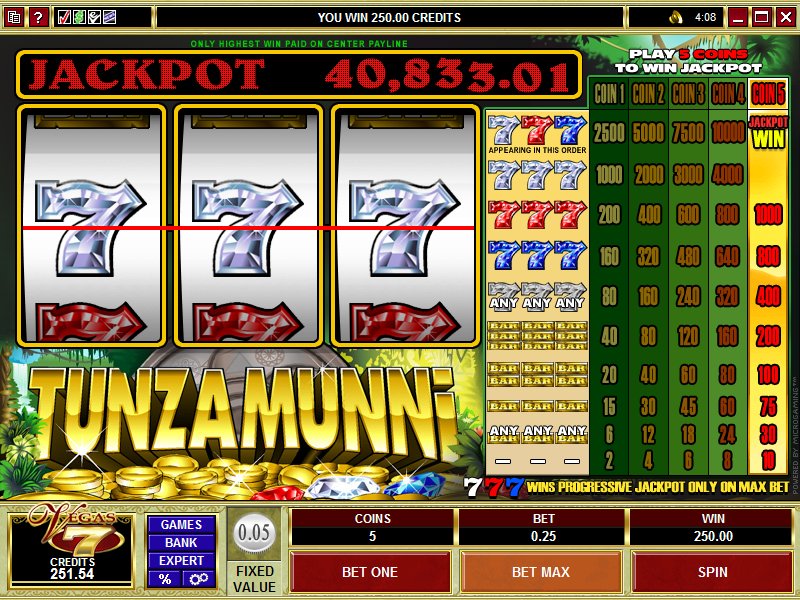
That is true only of the super-big jackpots like Megabucks and Wheel of Fortune. When somebody wins a representative of IGT (the slot-maker) verifies the win is legitimate and then pays the winner. A portion of each bet made goes to a fund to pay the progressive.
According to Nevada Gaming Control Board regulation 5.110.5(c), the casino licensee must add the progressive jackpot to a similar game at the same establishment.
I agree with your hypothesis, that they pulled out the Quartermania machines and rolled the progressive jackpot into Wheel of Fortune. It can't be a coincidence.
Here in Nevada the casino would have to roll the progressive jackpot into another game, per Nevada Gaming Control Board regulation 5.110.5(c). If there is any such policy at Foxwoods I am unaware of it. If Foxwoods would like to express their version in this forum I would be happy to accept their statement.
You’re welcome. I don’t guarantee this as fact, but here is how I believe it works. First, the point at which the jackpot hits is randomly chosen between $50,000 and $100,000. I think each hit point is equally likely.
When the meter crosses the predestined hit point, everybody with a slot card in and playing will win $50 in fee play. To be considered “playing” the player must have his player card inserted, and have made a bet within the last ten seconds. Then, somehow, a machine is chosen at random from all those being actively played to win the Jumbo Jackpot. It does not appear that the bet amount matters, so all qualifying machines have the same probability of being chosen. As long as you can actively play multiple machines, that would muliply your chances of the jackpot by number of machines played, and you would qualify for the free play on all of them.
I would like to thank Bob Dancer for his help with this question.
Note: This answer has been updated in June, 2008, after a rule change to the Jumbo Jackpot.
As usual, the person asking the question is right. For the benefit of other readers, I indicate the rules in my March 4, 2008, column. The probability of the jackpot hitting is inversely proportional to the how far the jackpot is from the guaranteed hit point of $100,000. The closer you get to $100,000 there is a smaller range where the jackpot can hit, so the odds of hitting at any given moment go up. If the current jackpot is j, the probability it will hit before the jackpot goes up $1 (for j<=$99,999) is 1/(100,000-j). At a jackpot of $50,000 the probability of hitting before going up $1 is 0.002%. At a jackpot of $99,999, the probability of hittng before going up $1 is 100%. So, you win the bet.
No, there isn’t. I don’t like it any more than you do. I think the player should be allowed to know the rules and/or the odds about what he is gambling on. Others have asked me if invoking the state Freedom of Information Act. I tend to doubt it would help or apply. As far as I know, the only place with such a right to know might be Holland. I’m told in Amsterdam information about the virtual reel stripping is indicated in little cards on the machines. You could in theory calculate the odds with that information and the pay table.
Progressive Slot Machines Winners
I saw a $1 progressive jackpot at a casino in Michigan based on the flop and player’s two hole cards. It pays as follows: Royal flush: 100% of jackpot
Straight flush: 10% of jackpot
Four of a kind: $300
Full house: $50
Flush: $40
Straight: $30
Three of a kind: $9
What would be the odds on a $105,000 jackpot?
The return for a jackpot of j is 0.530569 + j×0.029242. So, if j=105,000, the return would be 83.76%. For more information, see my page on Ultimate Texas Hold ’Em.
Progressive Free Slots
The formula is V = P × [(1-(1+i)-n)]/(i/(1+i)), where:
V = value of annuity
P = individual payment amount
i = interest rate
n = number of payments
Let’s say the jackpot was $15M. Using i = 4.66%, and n=25, the fair payment to keep up with inflation would be $982,525. You would actually get 15M/25 = $600,000. Actual payment/fair payment = 61.07%.
Not that you asked, but the formula if the payments are made at the end of each year is V = P × [(1-(1+i)-n)]/i.
What Are Progressive Slots
This question was raised and discussed in the forum of my companion site Wizard of Vegas.